Mutual Information
From the book
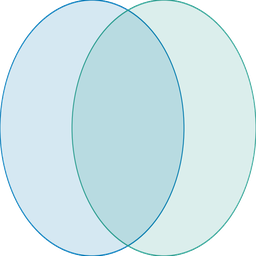
Chapter 14: Information Theory. In the chapter mind map this icon labels Mutual Information: $I(X;Y)$. The discussion below is excerpted and lightly edited from § Mutual Information in Mathematics for AI and Machine Learning.
For two random variables $X$ and $Y$ with joint distribution $p(x, y)$ and marginals $p(x)$ and $p(y)$, the mutual information is
Here $D_{\mathrm{KL}}(p \,\|\, q) = \sum_x p(x)\log\frac{p(x)}{q(x)} \ge 0$ is the KL divergence, studied in Section the referenced section. For continuous random variables, replace sums with integrals.
Mutual information measures how much knowing $X$ reduces the uncertainty about $Y$, and vice versa. It is $0$ exactly when $X$ and $Y$ are independent (independence), and for discrete variables at most $\min(H(X), H(Y))$, reached when one variable determines the other, as for $Y = X$; a noisy copy $Y = X + \varepsilon$ has $0 < I(X; Y) < H(X)$.
What this drawing shows
What you see. Represents shared information between random variables.
In the mind map. Chapter 14 — Mutual Information. See From the book above for definitions, figures, and worked examples.
Where to read next
Read the full definitions, figures, and worked examples in Chapter 14: Information Theory — see the mind-map node Mutual Information.