Stochastic Variational Inference
Chapter 16: Variational Inference and Latent Variables — Stochastic Variational Inference
From the book
Chapter 16: Variational Inference and Latent Variables. In the chapter mind map this icon labels Stochastic VI(SVI). The discussion below is excerpted and lightly edited from § Stochastic Variational Inference in Mathematics for AI and Machine Learning.
Variational Inference (VI)[^variational-note] approximates the intractable posterior $p_{\boldsymbol\theta}(\mathbf z | \mathbf x)$ with a simpler variational distribution $q_{\boldsymbol\phi}(\mathbf z)$ parameterized by variational parameters $\boldsymbol\phi$, chosen from a restricted family of distributions $\mathcal{Q}$.
[^variational-note]: The term "variational" comes from the calculus of variations, a branch of mathematics that deals with optimizing over functions rather than just parameters. In variational inference, we optimize over a family of distributions (functions) to find the best approximation to the true posterior, searching through a variational family $\mathcal{Q}$ of tractable distributions.
The variational family $\mathcal{Q}$ is a constrained set of distributions (not all possible distributions) chosen for computational tractability. The choice of $\mathcal{Q}$ balances expressiveness (approximation quality) and computational efficiency (optimization and expectation computation). Common choices include Gaussian distributions, mean field distributions (factorized into independent components: $q(\mathbf z) = \prod_{i=0}^{k-1} q_i(z_i)$), or distributions parameterized by neural networks.
The variational parameters $\boldsymbol\phi$ define the specific distribution within this family. For example, if $q$ is Gaussian, then $\boldsymbol\phi = \{\boldsymbol\mu, \boldsymbol\Sigma\}$; if $q$ is parameterized by a neural network (as in VAEs), then $\boldsymbol\phi$ represents the encoder network's weights and biases.
The goal is to find $q^_{\boldsymbol\phi^}(\mathbf z) \in \mathcal{Q}$ that minimizes the KL divergence from $q$ to the true posterior:
Here, $q^$ denotes the optimal variational distribution (the best approximation within the family $\mathcal{Q}$), and $\boldsymbol\phi^$ denotes the optimal variational parameters that achieve this minimum. The asterisk ($^*$) notation is standard mathematical notation for optimal values.
What this drawing shows
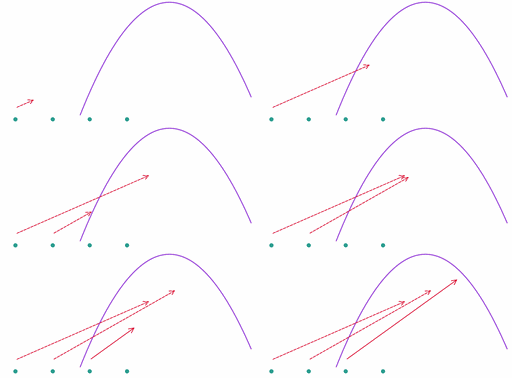
What you see. Green mini-batch and purple ELBO curve fixed; red stochastic gradient arrows grow sequentially from batch samples toward the objective.
In the mind map. Chapter 16 — Stochastic VI(SVI). See From the book above for definitions, figures, and worked examples.
Where to read next
Read the full definitions, figures, and worked examples in Chapter 16: Variational Inference and Latent Variables — see the mind-map node Stochastic VI(SVI).