Brownian Motion
Chapter 19: Stochastic Differential Equations — Brownian Motion & Wiener Process ($dW_t$)
From the book
Chapter 19: Stochastic Differential Equations. In the chapter mind map this icon labels Brownian Motion & Wiener Process ($dW_t$). The discussion below is excerpted and lightly edited from § Definition: Brownian Motion in Mathematics for AI and Machine Learning.
A Brownian motion (also called a Wiener process) $\{\mathbf{W}_t\}_{t \ge 0}$ in $\mathbb{R}^d$ is a stochastic process satisfying:
1. Initial condition: $\mathbf{W}_0 = \mathbf{0}$ almost surely 2. Independent increments: For $0 \le t_0 < t_1 < \cdots < t_n$, the increments $\mathbf{W}_{t_1} - \mathbf{W}_{t_0}, \mathbf{W}_{t_2} - \mathbf{W}_{t_1}, \ldots, \mathbf{W}_{t_n} - \mathbf{W}_{t_{n-1}}$ are independent 3. Gaussian increments: For $t > s \ge 0$, $\mathbf{W}_t - \mathbf{W}_s \sim \mathcal{N}(\mathbf{0}, (t-s)I)$ 4. Continuous paths: The sample paths $t \mapsto \mathbf{W}_t(\omega)$ are almost surely continuous functions
These properties uniquely characterize Brownian motion up to a scaling factor.
What this drawing shows
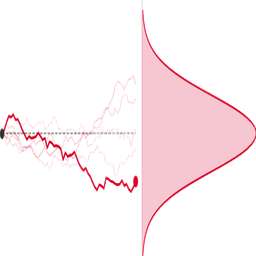
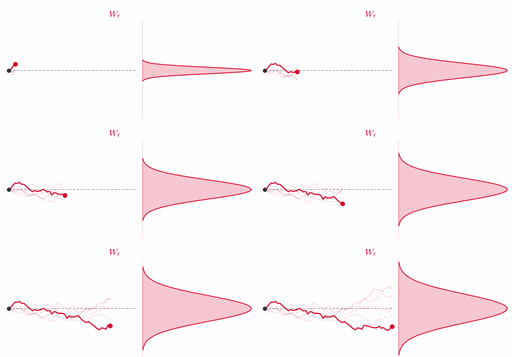
What you see. Five $W_t$ paths fluctuate around dashed $\mathbb{E}[W_t]=0$; Gaussian marginal $\mathcal{N}(0,t)$ widens on the right as time advances.
In the mind map. Chapter 19 — Brownian Motion & Wiener Process (). See From the book above for definitions, figures, and worked examples.
Where to read next
Read the full definitions, figures, and worked examples in Chapter 19: Stochastic Differential Equations — see the mind-map node Brownian Motion & Wiener Process ().