Graph Laplacian
From the book
Chapter 7: Symmetric Matrix. In the chapter mind map this icon labels Graph Laplacian: Spectral Methods & GNNs. The discussion below is excerpted and lightly edited from § Spectral Decomposition of Graph Laplacian in Mathematics for AI and Machine Learning.
Since $L$ is symmetric and positive semi-definite, it admits a spectral decomposition:
where $\Lambda = \mathrm{diag}(\lambda_0, \lambda_1, \ldots, \lambda_{N-1})$ with $0 = \lambda_0 \le \lambda_1 \le \cdots \le \lambda_{N-1}$, and $Q = [\mathbf q_0, \mathbf q_1, \ldots, \mathbf q_{N-1}]$ is orthonormal. The smallest eigenvalue $\lambda_0 = 0$ has eigenvector $\mathbf q_0 = \frac{1}{\sqrt{N}}\mathbf 1$ (constant vector) if the graph is connected. The number of zero eigenvalues equals the number of connected components in the graph.
The eigenvalues $\lambda_n$ are called the graph frequencies, and the eigenvectors $\mathbf q_n$ are the graph Fourier modes. This terminology comes from signal processing. The constant eigenvector $\mathbf q_0$ (corresponding to $\lambda_0 = 0$) represents the DC component (0 Hz), which is the average value of the signal across all nodes. The Fiedler vector $\mathbf q_1$ (corresponding to $\lambda_1$) is the lowest frequency wave, like a sine wave that crosses zero once, creating a natural bipartition of the graph. Large eigenvalues $\lambda_{N-1}$ correspond to high frequency noise, where adjacent nodes have alternating signs ($+$, $-$, $+$, $-$), representing rapid oscillations. Low frequencies correspond to smooth signals (slowly varying across the graph), while high frequencies correspond to oscillatory signals (rapidly varying).
What this drawing shows
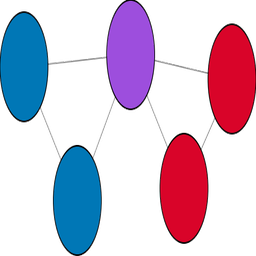
What you see. Shows node connectivity and smoothing structure captured by a graph Laplacian matrix.
In the mind map. Chapter 7 — Graph Laplacian: Spectral Methods & GNNs. See From the book above for definitions, figures, and worked examples.
Where to read next
Read the full definitions, figures, and worked examples in Chapter 7: Symmetric Matrix — see the mind-map node Graph Laplacian: Spectral Methods & GNNs.