Rayleigh Quotient
Chapter 7: Symmetric Matrix — Rayleigh Quotient $R(x)$ & Spectral Norm Bounds
From the book
Chapter 7: Symmetric Matrix. In the chapter mind map this icon labels Rayleigh Quotient $R(x)$ & Spectral Norm Bounds. The discussion below is excerpted and lightly edited from § Theorem: Rayleigh Quotient Bounds in Mathematics for AI and Machine Learning.
Let $\lambda_{\min}$ and $\lambda_{\max}$ be the smallest and largest eigenvalues of a symmetric matrix $A \in \mathbb{R}^{N \times N}$. For any nonzero vector $\mathbf x \in \mathbb{R}^{N \times 1}$, the Rayleigh quotient (see @eq:rayleigh-quotient) satisfies
Each bound is tight: the lower bound is achieved when $\mathbf x$ is an eigenvector corresponding to $\lambda_{\min}$, and the upper bound is achieved when $\mathbf x$ is an eigenvector corresponding to $\lambda_{\max}$.
What this drawing shows
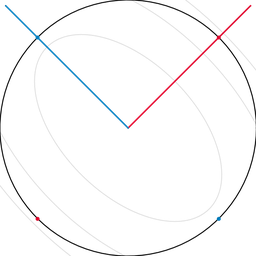
What you see. Shows how a vector probes eigenvalue-like curvature of a symmetric matrix.
In the mind map. Chapter 7 — Rayleigh Quotient & Spectral Norm Bounds. See From the book above for definitions, figures, and worked examples.
Where to read next
Read the full definitions, figures, and worked examples in Chapter 7: Symmetric Matrix — see the mind-map node Rayleigh Quotient & Spectral Norm Bounds.