KL Divergence
From the book
Chapter 14: Information Theory. In the chapter mind map this icon labels **KL Divergence: $D_{\mathrm{KL}}(P \parallel Q)$. The discussion below is excerpted and lightly edited from § KL Divergence** in Mathematics for AI and Machine Learning.
For two probability distributions over the same space, the Kullback-Leibler (KL) divergence is defined as follows. For discrete distributions with probability mass functions $p(x)$ and $q(x)$, and for continuous distributions with probability density functions $f(x)$ and $g(x)$:
KL divergence measures the expected extra information (or "surprise") when using distribution $q$ to encode events that actually follow distribution $p$, or equivalently, the amount of information lost when using $q$ to replace $p$. In machine learning, $p$ typically represents the true data distribution and $q$ represents the model distribution. Minimizing $D_{\mathrm{KL}}(p || q)$ makes the model $q$ match the data distribution $p$.
Following standard convention, we use lowercase $p$ and $q$ as generic notation for probability distributions (PMFs for discrete, PDFs for continuous). When the context is clear, we write $D_{\mathrm{KL}}(p || q)$ for both cases.
the book figure shows the setting the definition requires: $P$ and $Q$ live on the same sample space $\{1, \ldots, m\}$, so $p(x)/q(x)$ is defined at every outcome. The divergence accumulates where the two disagree, weighted by $p(x)$, and vanishes where the bars coincide.
What this drawing shows
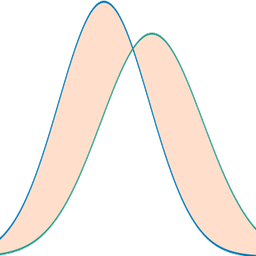
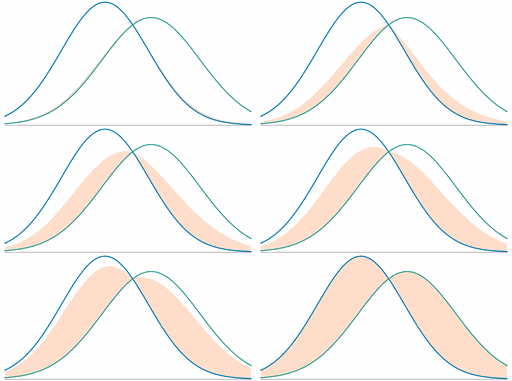
What you see. Blue $P$ and green $Q$ fixed; peach gap between the curves grows, visualizing $D_{\mathrm{KL}}(P \parallel Q)$.
In the mind map. Chapter 14 — KL Divergence. See From the book above for definitions, figures, and worked examples.
Where to read next
Read the full definitions, figures, and worked examples in Chapter 14: Information Theory — see the mind-map node KL Divergence.