Scaling
Chapter 6: Geometric Transformation and Eigen Decomposition — Scaling
From the book
Chapter 6: Geometric Transformation and Eigen Decomposition. In the chapter mind map this icon labels Scaling. The discussion below is excerpted and lightly edited from § Scaling in Mathematics for AI and Machine Learning.
Scaling transformations change the size or proportions of objects. When scaling is applied along the coordinate axes, the transformation is represented by a diagonal matrix.
In 2D, Uniform scaling scales all directions by the same factor $k$: In this case, the object's shape is preserved, and its area changes by a factor of $\det(S) = k^2$.
Non-uniform scaling (also called squeeze or stretch) uses different factors for each axis. In 2D, this is represented by: This changes the object's aspect ratio. The area changes by a factor of $\det(S) = k_1 k_2$. A special case where $k_1 k_2 = 1$ is called a squeeze mapping, which is area-preserving.
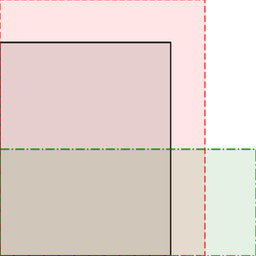
As shown in the book figure 2D uniform scaling (red dashed line, $k=1.2$) expands the square equally, while non-uniform scaling (green dash-dot line, $k_1=1.5, k_2=0.5$) stretches it horizontally and compresses it vertically. In both cases, the coordinate axes remain the principal directions of the transformation.
What this drawing shows
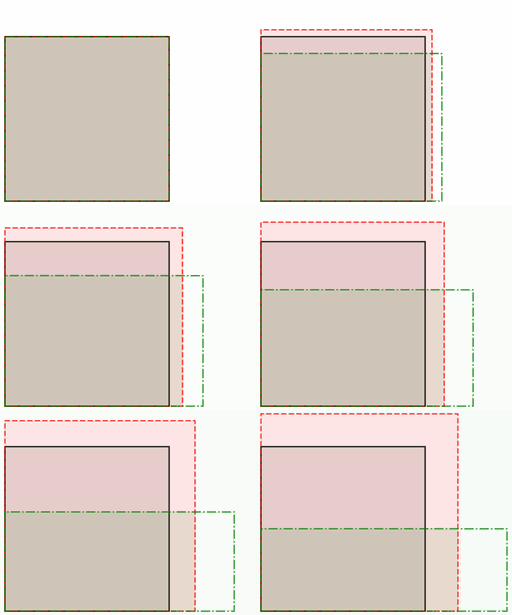
What you see. Shows a fixed black reference square with red (uniform) and green (non-uniform) copies scaling slowly from the identity to $k{=}1.2$ and $(k_1,k_2){=}(1.5,0.5)$, matching the chapter scaling figure.
In the mind map. Chapter 6 — Scaling. See From the book above for definitions, figures, and worked examples.
Where to read next
Read the full definitions, figures, and worked examples in Chapter 6: Geometric Transformation and Eigen Decomposition — see the mind-map node Scaling.