Schur Complement for Gaussian Processes
From the book
Chapter 10: Matrix Block Partitioning. In the chapter mind map this icon labels GP App: Schur Complement in Gaussian Processes. The discussion below is excerpted and lightly edited from § Theorem: Schur Complement in Mathematics for AI and Machine Learning.
where $A_{00} \in \mathbb{R}^{m \times m}$ is invertible. The Schur complement of $A_{00}$ in $A$ is defined as
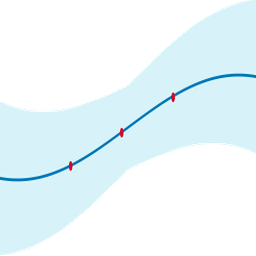
the book figure demonstrates the Schur complement in the context of Gaussian process regression. The plot shows training observations (red points) and the posterior mean prediction (blue line) with a 95% confidence interval (shaded blue region). The key insight is that the posterior variance at any test point is exactly the Schur complement $k_{} - \mathbf{k}_^\top K^{-1} \mathbf{k}_$, where $k_{}$ is the prior variance, $K$ is the covariance matrix of training points, and $\mathbf{k}_*$ is the covariance between training and test points. The shaded region represents the reduction in uncertainty (information gain) compared to the prior: near training points, the variance is small (high confidence), while far from training data, the variance approaches the prior variance. This visualization connects the abstract linear algebra concept of the Schur complement to the intuitive notion of "uncertainty reduction" in probabilistic modeling, making clear why the Schur complement is fundamental in Gaussian processes, Bayesian inference, and conditional probability computations.
What this drawing shows
What you see. Represents block Gaussian conditioning where a Schur complement gives posterior covariance or marginal uncertainty.
In the mind map. Chapter 10 — GP App: Schur Complement in Gaussian Processes. See From the book above for definitions, figures, and worked examples.
Where to read next
Read the full definitions, figures, and worked examples in Chapter 10: Matrix Block Partitioning — see the mind-map node GP App: Schur Complement in Gaussian Processes.