SVD Mapping Geometry
Chapter 8: Singular Value Decomposition (SVD) — Four Fundamental Subspaces Mapping
From the book
Chapter 8: Singular Value Decomposition (SVD). In the chapter mind map this icon labels **Four Fundamental Subspaces Mapping. The discussion below is excerpted and lightly edited from § Four Fundamental Subspaces Mapping** in Mathematics for AI and Machine Learning.
1. $\{\mathbf u_i\}_{i=0}^{r-1}$ spans $C(A)$ 2. $\{\mathbf v_i\}_{i=0}^{r-1}$ spans $C(A^\top)$ 3. $\{\mathbf v_i\}_{i=r}^{N-1}$ spans $N(A)$ 4. $\{\mathbf u_i\}_{i=r}^{M-1}$ spans $N(A^\top)$
The SVD provides a complete orthonormal basis for all four fundamental subspaces of a matrix. The first $r$ left singular vectors $\{\mathbf u_i\}_{i=0}^{r-1}$ form an orthonormal basis for the column space $C(A)$, while the first $r$ right singular vectors $\{\mathbf v_i\}_{i=0}^{r-1}$ span the row space $C(A^\top)$. The remaining right singular vectors $\{\mathbf v_i\}_{i=r}^{N-1}$ span the null space $N(A)$, and the remaining left singular vectors $\{\mathbf u_i\}_{i=r}^{M-1}$ span the left null space $N(A^\top)$. This elegant decomposition reveals that the singular vectors corresponding to non-zero singular values capture the range spaces, while those corresponding to zero singular values capture the null spaces, providing a unified geometric view of how $A$ maps vectors between $\mathbb{R}^N$ and $\mathbb{R}^M$.
What this drawing shows
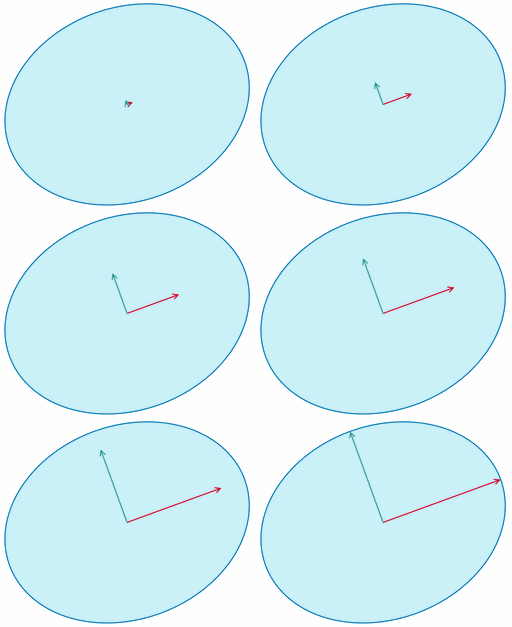
What you see. Blue ellipse image fixed; red $\sigma_1\mathbf{u}_1$ and green $\sigma_2\mathbf{u}_2$ singular axes grow from the center.
In the mind map. Chapter 8 — Four Fundamental Subspaces Mapping. See From the book above for definitions, figures, and worked examples.
Where to read next
Read the full definitions, figures, and worked examples in Chapter 8: Singular Value Decomposition (SVD) — see the mind-map node Four Fundamental Subspaces Mapping.