Denoising Score Matching
Chapter 17: Score Function and Energy-Based Models — Denoising Score Matching (DSM) objective
From the book
Chapter 17: Score Function and Energy-Based Models. In the chapter mind map this icon labels Denoising Score Matching (DSM) objective. The discussion below is excerpted and lightly edited from § Denoising Score Matching (DSM) in Mathematics for AI and Machine Learning.
While score matching is theoretically elegant, it faces practical challenges in high dimensions:
- Manifold structure: Real data (e.g., natural images) lies on a low-dimensional manifold embedded in high-dimensional space. The true data distribution $p_{\text{data}}(\mathbf{x})$ has zero probability mass almost everywhere, making $\nabla \log p_{\text{data}}(\mathbf{x})$ undefined or unstable at most points.
- Sparse data: In high dimensions, data samples are sparse. The score function $\nabla \log p_{\text{data}}(\mathbf{x})$ is only well-defined near the data manifold, but we need to learn it everywhere for effective sampling.
- Numerical instability: Computing $\frac{\partial s_{\theta,i}(\mathbf{x})}{\partial x_i}$ (second derivatives) can be numerically unstable, especially when the learned distribution is sharp or multi-modal.
What this drawing shows
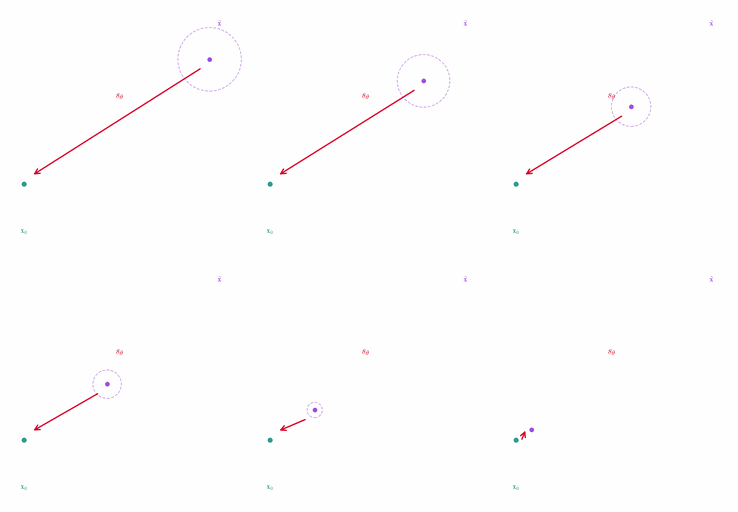
What you see. Shows a noisy sample $\tilde{\mathbf{x}}$ converging toward clean data $\mathbf{x}_0$ along the learned score direction $s_\theta$.
In the mind map. Chapter 17 — Denoising Score Matching (DSM) objective. See From the book above for definitions, figures, and worked examples.
Where to read next
Read the full definitions, figures, and worked examples in Chapter 17: Score Function and Energy-Based Models — see the mind-map node Denoising Score Matching (DSM) objective.