Fisher Divergence
Chapter 17: Score Function and Energy-Based Models — Fisher Divergence Score Matching
From the book
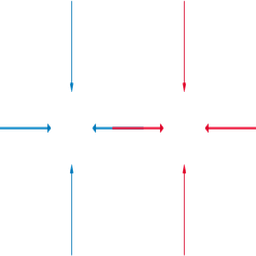
Chapter 17: Score Function and Energy-Based Models. In the chapter mind map this icon labels Fisher Divergence Score Matching. The discussion below is excerpted and lightly edited from § Fisher Divergence Score Matching in Mathematics for AI and Machine Learning.
Given samples $\{\mathbf{x}^{(n)}\}_{n=1}^N$ from an unknown data distribution $p_{\text{data}}(\mathbf{x})$, we want a score model $\mathbf{s}_\theta(\mathbf{x})$ with
Only samples are available, not the density, so $\nabla_{\mathbf{x}} \log p_{\text{data}}(\mathbf{x})$ cannot serve as a training target. Score matching (Hyvärinen, 2005) uses integration by parts to turn the distance between the two scores into an objective that depends on the data only through expectations, which samples can estimate.
What this drawing shows
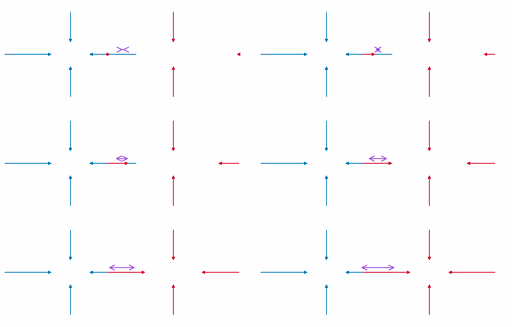
What you see. True score field $s$ (blue) fixed; red $s_\theta$ arrows shrink inward and the purple gap closes as the Fisher objective is minimized.
In the mind map. Chapter 17 — Fisher Divergence Score Matching. See From the book above for definitions, figures, and worked examples.
Where to read next
Read the full definitions, figures, and worked examples in Chapter 17: Score Function and Energy-Based Models — see the mind-map node Fisher Divergence Score Matching.