Energy-Based Model
Chapter 17: Score Function and Energy-Based Models — Energy-Based Models
From the book
Chapter 17: Score Function and Energy-Based Models. In the chapter mind map this icon labels Energy-Based Models. The discussion below is excerpted and lightly edited from § Energy-Based Models in Mathematics for AI and Machine Learning.
For an EBM specifically, where $f(\mathbf{x}) = \exp(-E_\theta(\mathbf{x}))$, this simplification becomes:
This confirms that the score function of an EBM equals the negative gradient of its energy function, completely eliminating the intractable partition function $Z_\theta$ from the computation. This remarkable property allows us to learn the score function without ever evaluating the normalization constant, even for high-dimensional distributions where integration is infeasible.
What this drawing shows
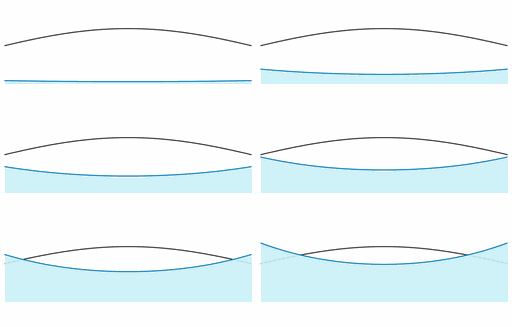
What you see. Energy landscape $E(x)$ fixed; Boltzmann density $e^{-E}$ grows from flat, showing $p(x) \propto \exp(-E(x))$.
In the mind map. Chapter 17 — Energy-Based Models. See From the book above for definitions, figures, and worked examples.
Where to read next
Read the full definitions, figures, and worked examples in Chapter 17: Score Function and Energy-Based Models — see the mind-map node Energy-Based Models.