Duality
From the book
Chapter 12: Optimization Methods. In the chapter mind map this icon labels Duality: Primal/Dual Bounds & Gap. The discussion below is excerpted and lightly edited from § Duality in Mathematics for AI and Machine Learning.
Constrained optimization can be studied by turning it into an unconstrained object that encodes both the objective and the constraints. The dual problem maximizes a lower bound on the primal optimum; when that bound is tight, we obtain strong duality and the Karush–Kuhn–Tucker (KKT) conditions characterize optimality.
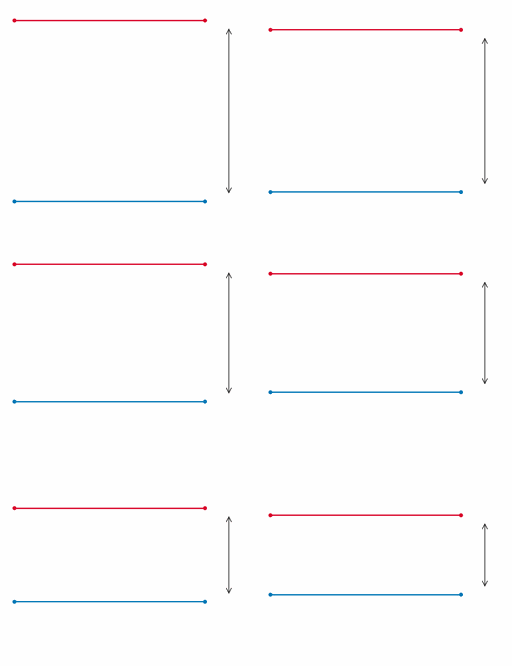
What this drawing shows
What you see. Primal bound $p^$ and dual bound $d^$ fixed; the optimization gap shrinks as the bounds converge.
In the mind map. Chapter 12 — Duality: Primal/Dual Bounds & Gap. See From the book above for definitions, figures, and worked examples.
Where to read next
Read the full definitions, figures, and worked examples in Chapter 12: Optimization Methods — see the mind-map node Duality: Primal/Dual Bounds & Gap.