Null Space
Chapter 3: Subspaces and Orthogonality — Null $\mathcal{N}(A)$ & Left Null $\mathcal{N}(A^\top)$
From the book
Chapter 3: Subspaces and Orthogonality. In the chapter mind map this icon labels Null $\mathcal{N}(A)$ & Left Null $\mathcal{N}(A^\top)$. The discussion below is excerpted and lightly edited from § Theorem: Rank-Nullity Theorem in Mathematics for AI and Machine Learning.
For any matrix $A \in \mathbb{R}^{M \times N}$ with rank $r$:
The Rank-Nullity Theorem is one of the most fundamental results in linear algebra. It states that the dimension of the column space (the "range" of the transformation) plus the dimension of the null space (the "kernel") equals the number of columns. This theorem has profound implications: if a matrix has many independent columns (high rank), it has a small null space, meaning the transformation is "injective" on a large subspace. Conversely, if the rank is low, the null space is large, meaning many inputs map to zero. See also: The definition of rank is introduced in the matrix chapter. Numerical methods for computing rank (via QR decomposition and SVD) are covered in the matrix chapter.
What this drawing shows
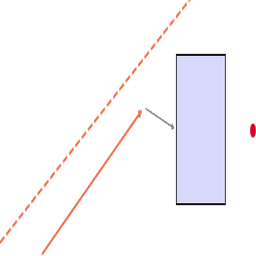
What you see. Highlights directions mapped to zero by a matrix, capturing solutions of homogeneous linear systems.
In the mind map. Chapter 3 — Null & Left Null. See From the book above for definitions, figures, and worked examples.
Where to read next
Read the full definitions, figures, and worked examples in Chapter 3: Subspaces and Orthogonality — see the mind-map node Null & Left Null.