Rotation
Chapter 3: Subspaces and Orthogonality — 2D Rotation Matrices (also appears in Ch. 6)
From the book
Chapter 3: Subspaces and Orthogonality. In the chapter mind map this icon labels 2D Rotation Matrices. The discussion below is excerpted and lightly edited from § Complex Numbers and 2D Rotation Matrices in Mathematics for AI and Machine Learning. Related material also appears in Chapter 6 (Rotation).
There is a natural correspondence between complex number multiplication and 2D rotation matrices. Consider the rotation matrix that rotates a vector in $\mathbb{R}^2$ counterclockwise by angle $\theta$:
Multiplying a 2D vector $\begin{pmatrix} x \\ y \end{pmatrix}$ by $R(\theta)$ is equivalent to treating $(x, y)$ as the complex number $z = x + iy$ and multiplying by $e^{i\theta}$:
which corresponds to $(x + iy) \cdot e^{i\theta} = (x + iy)(\cos\theta + i\sin\theta) = (x\cos\theta - y\sin\theta) + i(x\sin\theta + y\cos\theta)$.
This correspondence extends to eigenvalues: the rotation matrix $R(\theta)$ has eigenvalues $e^{i\theta}$ and $e^{-i\theta}$, both with modulus 1, reflecting the fact that rotations preserve distances.
What this drawing shows
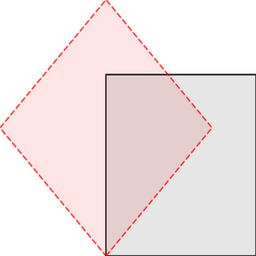
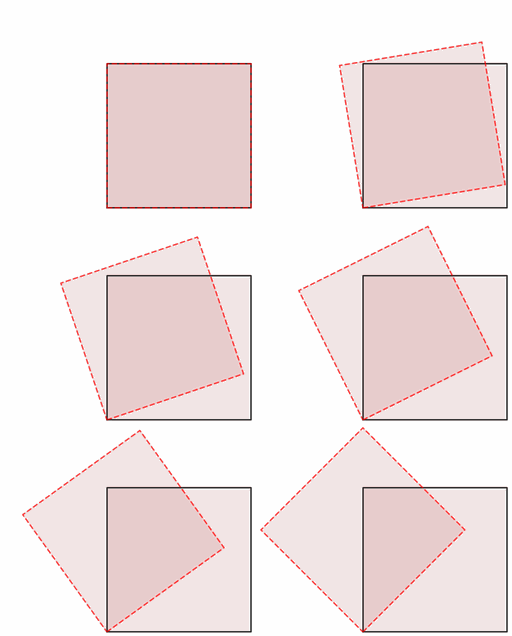
What you see. Shows a fixed black reference square and a red dashed copy rotating slowly about the bottom-left corner from 0° to 45°, matching the chapter rotation figure.
In the mind map. Chapter 3 — 2D Rotation Matrices. See From the book above for definitions, figures, and worked examples.
Also appears in Ch. 6 (Rotation).
Where to read next
Read the full definitions, figures, and worked examples in Chapter 3: Subspaces and Orthogonality — see the mind-map node 2D Rotation Matrices.
This concept is also referenced in Chapter 6 (Rotation).