Rotation on Unit Circle
Chapter 3: Subspaces and Orthogonality — Euler's Formula and Complex Rotations
From the book
Chapter 3: Subspaces and Orthogonality. In the chapter mind map this icon labels Euler's Formula ($e^{i\theta}$). The discussion below is excerpted and lightly edited from § Euler's Formula and Complex Rotations in Mathematics for AI and Machine Learning.
Euler's formula establishes a fundamental connection between complex exponentials and trigonometric functions:
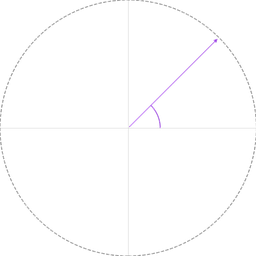
where $\theta \in \mathbb{R}$ is a real angle. This formula implies that $|e^{i\theta}| = \sqrt{\cos^2\theta + \sin^2\theta} = 1$, so $e^{i\theta}$ lies on the unit circle in the complex plane. Multiplying a complex number by $e^{i\theta}$ rotates it counterclockwise by angle $\theta$ around the origin.
From Euler's formula, we can express trigonometric functions in terms of complex exponentials:
What this drawing shows
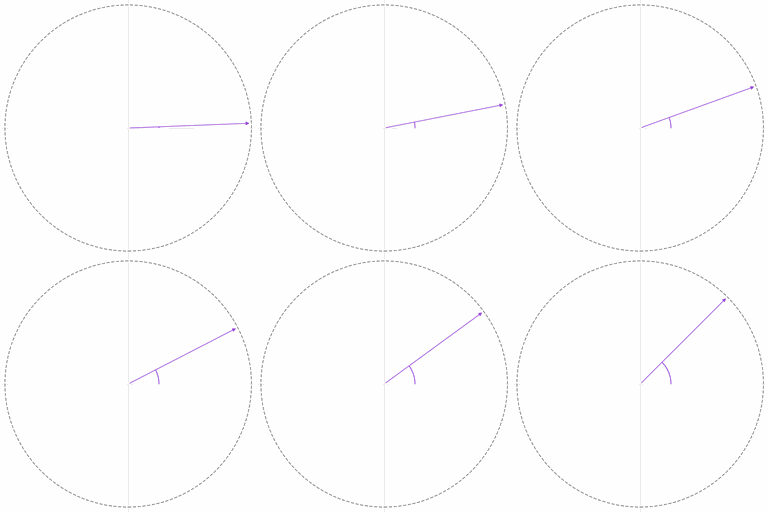
What you see. Unit circle and axes fixed; purple vector $e^{i\theta}$ rotates from the real axis to $45^\circ$ while the angle arc grows.
In the mind map. Chapter 3 — Euler's Formula (). See From the book above for definitions, figures, and worked examples.
Where to read next
Read the full definitions, figures, and worked examples in Chapter 3: Subspaces and Orthogonality — see the mind-map node Euler's Formula ().