SGLD
Chapter 18: Langevin Dynamics and Sampling — Stochastic Gradient Langevin Dynamics
From the book
Chapter 18: Langevin Dynamics and Sampling. In the chapter mind map this icon labels Stochastic Gradient Langevin Dynamics. The discussion below is excerpted and lightly edited from § Stochastic Gradient Langevin Dynamics (SGLD) in Mathematics for AI and Machine Learning.
The standard Langevin dynamics algorithm requires computing the exact gradient of the log-density $\nabla_{\mathbf{x}} \log p(\mathbf{x})$ at each iteration. However, in modern machine learning scenarios with large datasets, this presents significant challenges:
- Computational Cost: Computing gradients using the entire dataset (full-batch) is prohibitively expensive for large-scale models and datasets
- Memory Constraints: Storing the entire dataset in memory is often impossible
- Online Learning: Many applications require learning from streaming data where the full dataset is never available
What this drawing shows
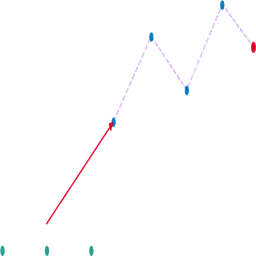
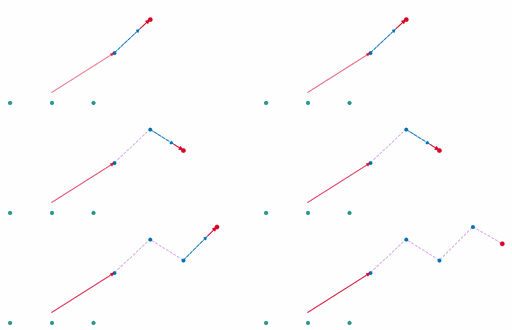
What you see. Mini-batch gradient (green) drives a noisy Langevin chain (purple); animation extends the sample path with drift (blue) plus noise (red) steps.
In the mind map. Chapter 18 — Stochastic Gradient Langevin Dynamics. See From the book above for definitions, figures, and worked examples.
Where to read next
Read the full definitions, figures, and worked examples in Chapter 18: Langevin Dynamics and Sampling — see the mind-map node Stochastic Gradient Langevin Dynamics.