Zero-Order Hold
Chapter 20: ODE, SDE, and Continuous Limits of Algorithms — Zero-Order Hold (ZOH)
From the book
Chapter 20: ODE, SDE, and Continuous Limits of Algorithms. In the chapter mind map this icon labels Zero-Order Hold (ZOH). The discussion below is excerpted and lightly edited from § Zero-Order Hold (ZOH) in Mathematics for AI and Machine Learning.
Assuming the input $\mathbf{u}(t)$ is constant over each interval $[k\Delta, (k+1)\Delta)$, the exact discrete-time equivalent is:
- Exact for piecewise-constant inputs
- Preserves stability: if $\mathrm{Re}(\lambda_i) < 0$ for all eigenvalues of $A$, then $|\mu_i| < 1$ for all eigenvalues of $\bar{A}$
- Requires computing matrix exponential (can be expensive)
What this drawing shows
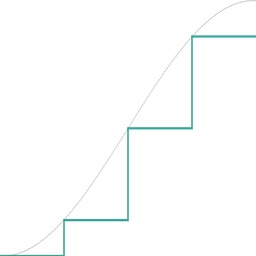
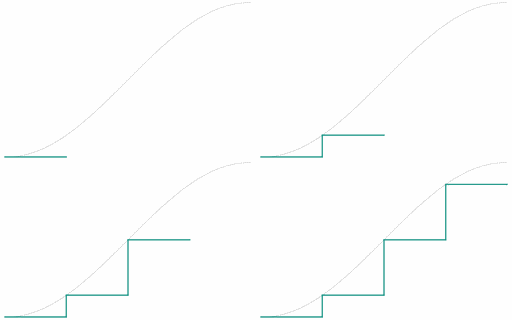
What you see. Gray continuous signal dashed; green zero-order-hold stair steps build left to right, holding each sample until the next grid time.
In the mind map. Chapter 20 — Zero-Order Hold (ZOH). See From the book above for definitions, figures, and worked examples.
Where to read next
Read the full definitions, figures, and worked examples in Chapter 20: ODE, SDE, and Continuous Limits of Algorithms — see the mind-map node Zero-Order Hold (ZOH).