Fokker-Planck Equation
Chapter 21: Fokker-Planck and Distribution Dynamics — Fokker-Planck Equation
From the book
Chapter 21: Fokker-Planck and Distribution Dynamics. In the chapter mind map this icon labels Fokker-Planck Equation: Drift & Diffusion Terms. The discussion below is excerpted and lightly edited from § Stationary Solution of the Langevin Fokker-Planck Equation in Mathematics for AI and Machine Learning.
When the distribution reaches the target distribution ($p_t = p$), the drift divergence becomes:
Substituting $p_t = p$ into the Fokker-Planck equation yields:
This confirms that $p$ is indeed a stationary (equilibrium) solution of the Langevin Fokker-Planck equation.
What this drawing shows
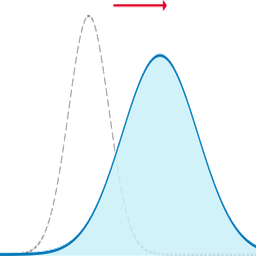
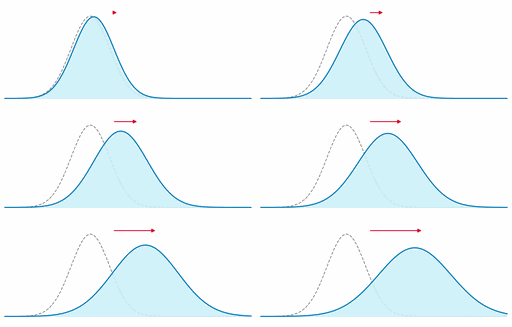
What you see. Shows $p(x,t)$ evolving under Fokker--Planck dynamics: gray dashed $p_0$ fixed while blue density drifts right and spreads (diffusion); red arrow tracks drift.
In the mind map. Chapter 21 — Fokker-Planck Equation: Drift & Diffusion Terms. See From the book above for definitions, figures, and worked examples.
Where to read next
Read the full definitions, figures, and worked examples in Chapter 21: Fokker-Planck and Distribution Dynamics — see the mind-map node Fokker-Planck Equation: Drift & Diffusion Terms.