Ornstein-Uhlenbeck (OU) Heat Flow
Chapter 21: Fokker-Planck and Distribution Dynamics — Ornstein-Uhlenbeck & Heat Equation Solutions
From the book
Chapter 21: Fokker-Planck and Distribution Dynamics. In the chapter mind map this icon labels **Ornstein-Uhlenbeck & Heat Equation Solutions. The discussion below is excerpted and lightly edited from § Ornstein-Uhlenbeck & Heat Equation Solutions** in Mathematics for AI and Machine Learning.
The solution of the heat equation with initial condition $p_0(\mathbf{x})$ is:
where $\ast$ denotes convolution and $\sigma_t^2 = \int_0^t \beta(s) ds$ is the accumulated variance.
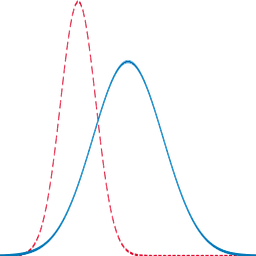
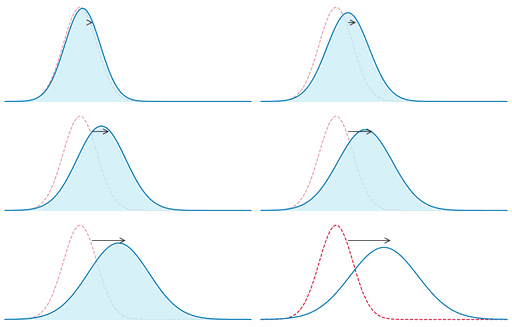
The distribution at time $t$ is the initial distribution $p_0$ convolved with a Gaussian kernel: each point of $p_0$ spreads into a Gaussian whose variance $\sigma_t^2$ grows with time, so $p_t$ becomes smoother and wider.
The density evolves linearly, but its logarithm and its score do not. In the variance variable $\tau = \sigma_t^2$ the equation is $\partial_\tau p = \frac{1}{2}\nabla^2 p$, and substituting $p = e^{u}$ gives
for $u = \log p$ and the score $\mathbf{s} = \nabla u$, using that $\nabla\mathbf{s}$ is the symmetric Hessian of $u$. In one dimension $-s$ solves the viscous Burgers equation $\partial_\tau w + w\,\partial_x w = \frac{1}{2}\partial_x^2 w$ of fluid dynamics: the logarithm is the Cole–Hopf transform of the optimal-control section run backward. A score network therefore learns the solution of a nonlinear equation, steep near the boundaries between modes at small $\tau$ and nearly linear, $\mathbf{s} \approx -\mathbf{x}/\tau$, at large $\tau$. For $p_0 = \mathcal N(0, s_0^2)$ the score $s = -x/(s_0^2 + \tau)$ is exactly linear, $s'' = 0$, and both sides of the equation equal $x/(s_0^2 + \tau)^2$.
What this drawing shows
What you see. Red initial peak fixed; blue density relaxes toward the mean and widens under OU / heat diffusion.
In the mind map. Chapter 21 — Ornstein-Uhlenbeck & Heat Equation Solutions. See From the book above for definitions, figures, and worked examples.
Where to read next
Read the full definitions, figures, and worked examples in Chapter 21: Fokker-Planck and Distribution Dynamics — see the mind-map node Ornstein-Uhlenbeck & Heat Equation Solutions.